
👉 ¿Prefieres practicar directamente? Tienes ejercicios con corrección automática: respondes, se corrigen solos y ves en qué fallas al momento.
¡Hola learner! Hoy vamos con una de las primeras cosas que se aprenden en inglés y una de las que más se siguen fallando: there is y there are, nuestro «hay». Te explico cuándo va cada uno, cómo se forman las preguntas y las negativas, cómo se dice «había» o «habrá», y el error que delata a casi todos los hispanohablantes. Al final tienes una ficha para practicarlo.
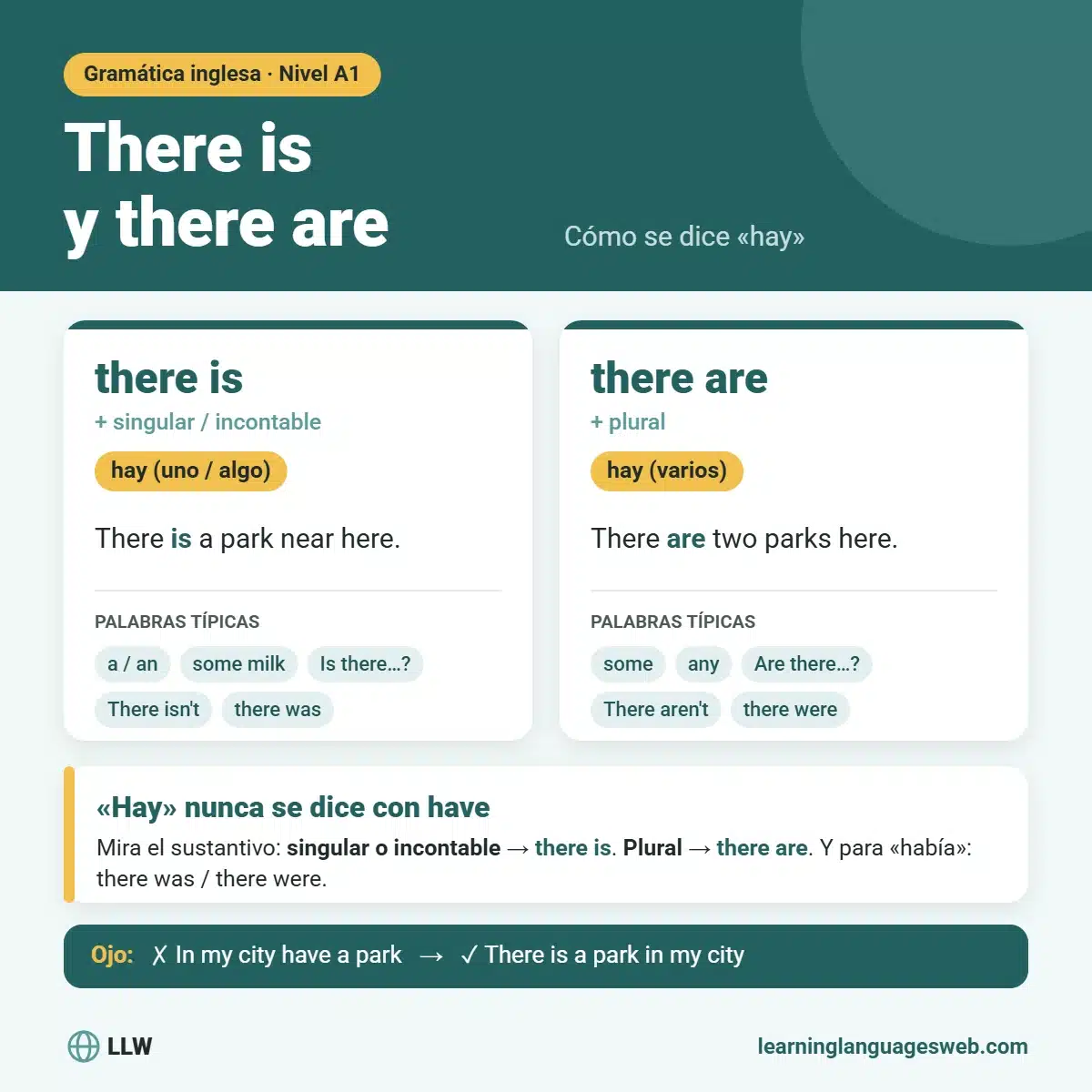
Respuesta rápida: there is («hay») va con sustantivos en singular o incontables («There is a dog», «There is some water»). There are va con plurales («There are three dogs»). Para preguntar se invierte el orden («Is there…?», «Are there…?») y para negar se añade not («There isn’t», «There aren’t»). Y nunca traduzcas «hay» con have.
Las formas de un vistazo
| Forma | Singular / incontable | Plural |
|---|---|---|
| Afirmativa | There is (there’s) a cat. | There are two cats. |
| Negativa | There isn’t a cat. / There isn’t any milk. | There aren’t any cats. |
| Pregunta | Is there a cat? | Are there any cats? |
| Respuesta corta | Yes, there is. / No, there isn’t. | Yes, there are. / No, there aren’t. |
¿Cuándo se utiliza cada uno?
La regla es sencilla: mira el sustantivo que va detrás.
- Singular → there is: There is a supermarket near my house.
- Incontable (water, money, time, information…) → there is: There is some coffee in the kitchen.
- Plural → there are: There are a lot of people in the street.
Con some y any: en afirmativa se suele usar some («There are some apples») y en negativas y preguntas any («Are there any apples?», «There aren’t any apples»). Para preguntar cantidades: How many + plural («How many students are there?») y How much + incontable («How much milk is there?»).
Había, hubo, habrá: there is en otros tiempos
| Tiempo | Singular / incontable | Plural |
|---|---|---|
| Pasado («había», «hubo») | There was a problem. | There were many problems. |
| Futuro («habrá») | There will be a meeting. | There will be two meetings. |
| Present perfect («ha habido») | There has been an accident. | There have been some changes. |
| Con going to («va a haber») | There is going to be a storm. | There are going to be delays. |
AnyVerb Academy
Ya sabes cómo va there is y there are. ¿Y el resto?
El test de nivel de AnyVerb mide gramática, lectura, escucha, escritura y voz en unos 10 minutos, y te dice por dónde empezar. Gratis y sin crear cuenta; para ver el resultado te pide tu email.
Hacer el test de nivel¿Prefieres que te avisemos? Apúntate a la lista de fundadores.
A tener en cuenta: errores típicos
| ❌ Incorrecto | ✅ Correcto | Por qué |
|---|---|---|
| In my city have a park. | There is a park in my city. | «Hay» no es have. |
| There is many people. | There are many people. | People es plural. |
| There are some milk. | There is some milk. | Milk es incontable. |
| Is there any apples? | Are there any apples? | Apples es plural. |
| There were a problem. | There was a problem. | En pasado también se distingue singular y plural. |
Un apunte: en inglés hablado se oye mucho there’s con plurales («There’s two people outside»). Es informal; al escribir y en exámenes usa there are.
There is, it is y they are: no los mezcles
There is presenta algo que existe («hay»). It is y they are hablan de algo que ya has mencionado. Por eso es muy natural usarlos seguidos:
- There is a new restaurant in my street. It’s very good.
- There are two cats in the garden. They are black.
Ficha de ejercicios
Practica lo que acabas de leer
12 ejercicios con corrección automática y explicación de cada fallo. Sin registro y sin descargar nada.
Preguntas frecuentes
¿Cuándo se usa «there is» y cuándo «there are»?
There is va con un sustantivo singular o incontable («There is a bank», «There is some milk»). There are va con plurales («There are two banks»). Los dos significan «hay».
¿Cómo se dice «había» y «habrá» en inglés?
«Había» es there was (singular) o there were (plural). «Habrá» es there will be, igual para singular y plural.
¿Por qué no se dice «In my city have a park»?
Porque «hay» no se traduce con have. En inglés se dice There is a park in my city: have es «tener».
Si quieres ver todos los temas ordenados, tienes la guía de gramática inglesa paso a paso. Y para afinar con las cantidades, mira much, many y a lot of.