
Ficha de ejercicios: phrasal verbs
12 ejercicios con corrección automática. No necesitas registrarte ni descargar nada: responde y pulsa Comprobar respuestas para ver en qué fallas y por qué.
AnyVerb Academy
Esta ficha mide un tema. ¿Y el resto de tu inglés?
El test de nivel de AnyVerb mide gramática, lectura, escucha, escritura y voz en unos 10 minutos, y te dice por dónde empezar. Gratis y sin crear cuenta; para ver el resultado te pide tu email.
Hacer el test de nivel¿Lo tienes claro? Reserva tu plaza de fundador (30 días gratis; solo 50 plazas).
← Vuelve a la teoría: Phrasal verbs
Ver las 16 preguntas de la ficha con sus soluciones
Intenta primero la ficha. Aquí tienes todas las preguntas que pueden salir, con la respuesta correcta y la explicación.
I ___ at seven every morning. (levantarse)
Solución: get up
Levantarse es get up, sin pronombre reflexivo.It's dark in here. Can you ___ the light? (encender)
Solución: turn on
Encender es turn on (o switch on).She ___ her little brother after school. (cuidar, presente)
Solución: looks after
Cuidar es look after; con she, looks after.I'm ___ my glasses. Have you seen them? (buscar)
Solución: looking for
Buscar algo que no encuentras es look for.He ___ smoking last year. (dejar de, pasado)
Solución: gave up
Dejar de hacer algo es give up; el pasado es gave up.We've ___ milk. Can you buy some? (quedarse sin)
Solución: run out of
Quedarse sin algo es run out of, con of.My car ___ on the way to work. (averiarse, pasado)
Solución: broke down
Averiarse es break down; el pasado es broke down.Please ___ this form with your details. (rellenar)
Solución: fill in
Rellenar un formulario es fill in (o fill out).I'm really looking forward to ___ you. (ver)
Solución: seeing
Detrás de look forward to va -ing, porque to es preposición.The music is too loud. Can you turn ___ down? (la música, con pronombre)
Solución: it
Con pronombre, va en medio: turn it down.I ___ that she was leaving the company. (enterarse, pasado)
Solución: found out
Enterarse o descubrir es find out; el pasado es found out.When are you ___ from your holiday? (volver)
Solución: coming back
Volver es come back; aquí va en continuous, coming back.¿Cuál es correcta?
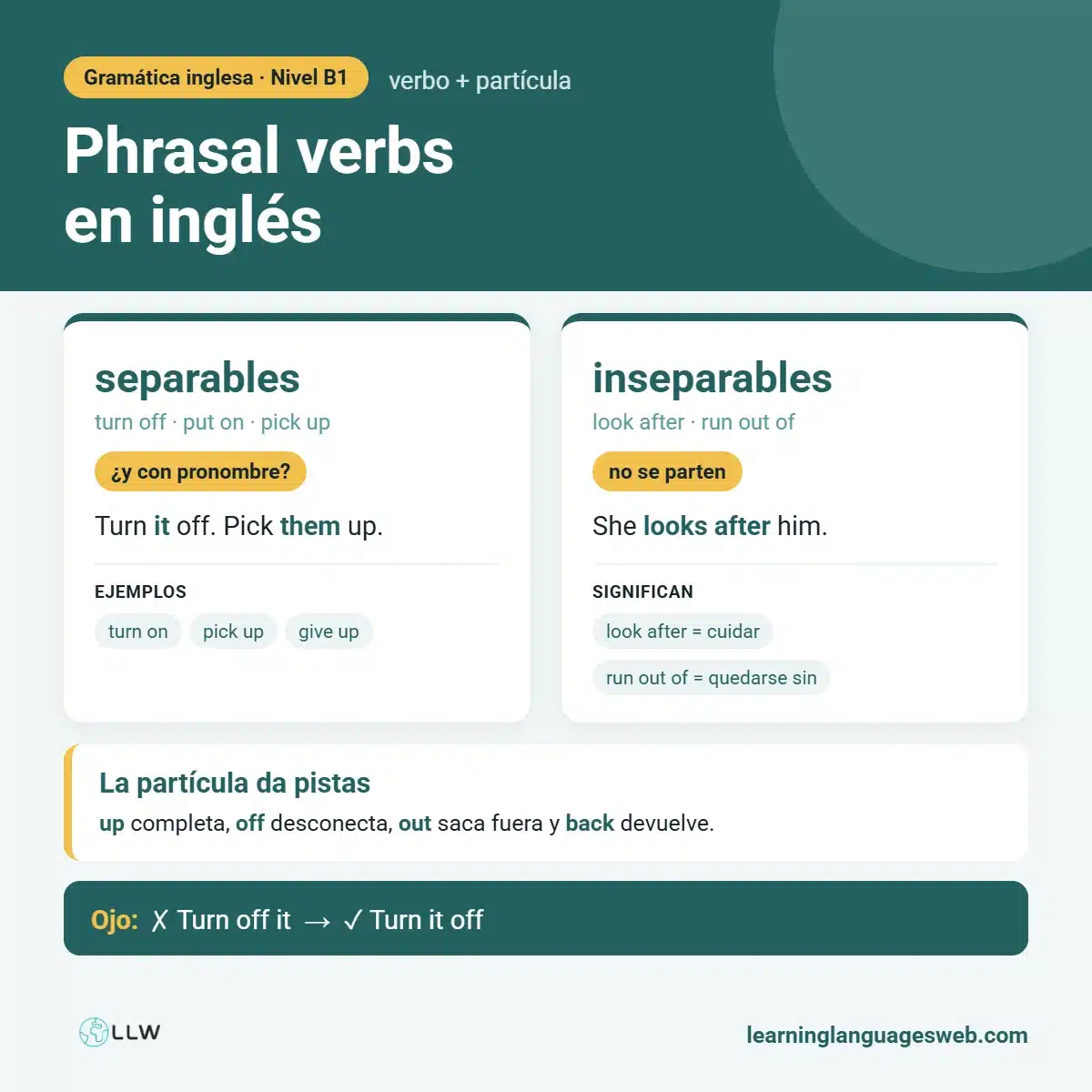
Opciones: Turn off it. · Turn it off.Solución: Turn it off.
Con pronombre, el phrasal verb separable se parte: turn it off.¿Cuál es correcta?
Opciones: She looks her son after. · She looks after her son.Solución: She looks after her son.
Look after es inseparable.«Me llevo muy bien con mi hermana»:
Opciones: I get on very well with my sister. · I get very well with my sister. · I carry on very well with my sister.Solución: I get on very well with my sister.
Llevarse bien con alguien es get on (well) with.«El avión despegó tarde»:
Opciones: The plane took off late. · The plane put off late. · The plane took out late.Solución: The plane took off late.
Despegar es take off.